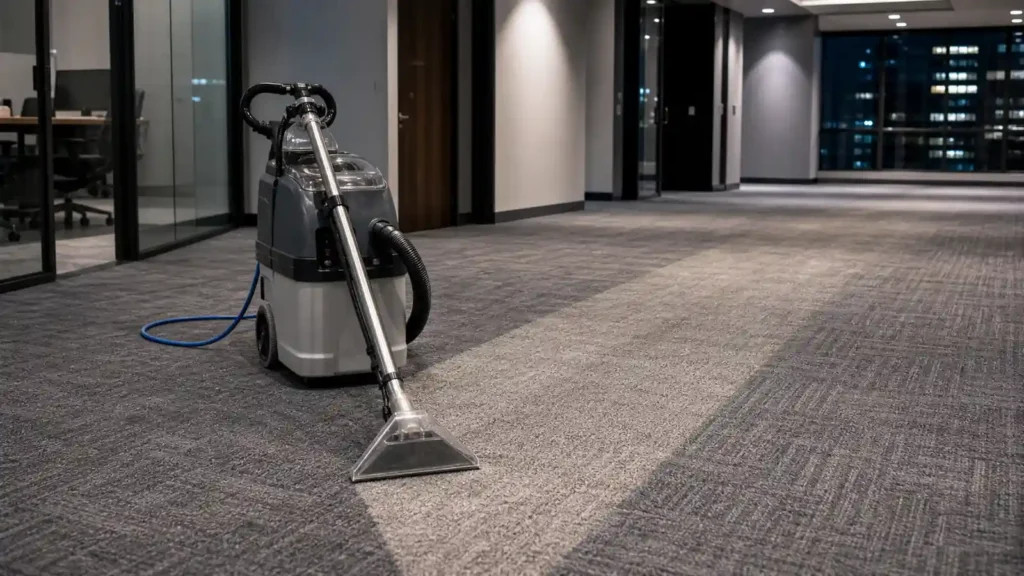
Post-construction cleaning goes wrong in a predictable way. The trades finish, someone books a single clean for the day before handover, and the crew discovers that eight weeks of drywall dust has settled into every horizontal surface, every duct, and the tracks of every window. The clean takes three times as long as quoted, and the space still is not right.
The fix is not a bigger crew on the last day. It is understanding that post-construction cleaning is three separate jobs at three separate points in the schedule.
What are the phases of post-construction cleaning?
Post-construction cleaning has three phases: a rough clean after framing and mechanical work, a final clean after trades finish and before handover, and a touch-up clean immediately before occupancy. Each removes a different kind of debris, and skipping the earlier phases makes the later ones substantially more expensive.
| Phase | When | Purpose | Skipping it costs you |
|---|---|---|---|
| Rough clean | After framing, mechanical, drywall | Bulk debris removal, make the site workable | Trades work slower, dust migrates everywhere |
| Final clean | After all trades, before handover | Detail clean of every surface and fixture | Handover fails, deficiency list grows |
| Touch-up | Just before occupancy | Settled dust, fingerprints, last marks | Client walks into a space that looks unfinished |
Phase one: the rough clean
The rough clean happens while work is still going on, once the heavy structural and mechanical trades are through. Its purpose is not presentation. It is to clear bulk debris so the remaining trades can work efficiently and so dust stops migrating into finished areas.
- Removal of construction debris, offcuts, packaging and waste
- Sweeping and vacuuming of all floor areas including stairwells
- Removal of stickers, labels and protective films where trades are finished
- Clearing debris from window tracks, door frames and mechanical rooms
- Initial dust knockdown on high surfaces, ledges and exposed ductwork
This is the phase most projects skip, and it is the one that determines what the final clean costs. Drywall dust that sits for six weeks bonds to surfaces and settles into places nobody can reach efficiently later. Removing it early is cheap. Removing it late is not.
Phase two: the final clean
This is what most people mean when they say post-construction cleaning. Every trade is finished, and the space has to go from a building site to something a client can be walked through.
- Full detail dusting from ceiling down, including light fixtures, vents, sprinkler heads and ledges
- Interior and exterior window cleaning where accessible, plus frames and tracks
- All millwork, cabinetry and shelving cleaned inside and out
- Fixtures, switch plates, door hardware and handrails detailed
- Washrooms fully cleaned and disinfected, including grout haze removal
- Kitchens and staff areas: appliances inside and out, counters, backsplashes
- Floor treatment appropriate to the surface, which is where most of the labour goes
- Removal of all remaining stickers, adhesive residue, paint specks and marks
Order matters here and it is not optional. Cleaning runs top to bottom, because anything else means cleaning floors twice. A crew that starts on the floors is telling you they have not done this before.
Why floors take the most time
New flooring arrives with manufacturing residue, adhesive, grout haze or protective coating depending on the material, and each needs a different treatment. New VCT usually needs sealing and finishing before occupancy, which is a strip and wax style process on a surface that has never been treated. Polished concrete needs a different approach again. Budgeting one line item for “floors” across mixed surfaces is how post-construction quotes go wrong.
Phase three: the touch-up clean
Between the final clean and occupancy, dust settles. Deficiency work gets done. People walk through with clipboards and leave fingerprints on glass. The touch-up clean is short, and it is the difference between a space that looks finished and one that looks nearly finished.
It covers settled dust on horizontal surfaces, glass and mirror marks, fingerprints on doors and hardware, washroom refresh, and a final floor pass. It should be scheduled as close to handover as the programme allows, ideally the day before.
Why construction dust is genuinely different
Ordinary commercial cleaning assumes ordinary soil. Construction dust behaves differently in three ways, and each one defeats a standard cleaning method.
It is far finer, so it stays airborne for hours and re-settles on surfaces that were already cleaned. It is abrasive, because it contains silica and mineral particles, so wiping it across a new surface can scratch it. And it gets everywhere, including inside cabinetry, above ceiling tiles, inside ductwork and into every track and reveal.
That is why the work needs HEPA filtration rather than a standard vacuum, damp methods rather than dry dusting, and multiple passes with settling time between them. A crew running a normal office routine will move dust around and leave scratches on new finishes.
Renovations in an occupied building
New builds are the easy case, because nobody is using the space. A renovation on the third floor of a working office building is a different problem: the dust does not respect the hoarding, and the people affected are tenants who did not choose the project.
Three things need to happen alongside the phase cleaning, and they belong in the scope from day one rather than after the first complaint.
Containment at the boundary
Tack mats at every exit from the work zone, sealed hoarding, and negative air where the work is heavy. Most dust migration happens through foot traffic rather than through the air, so the boundary is where it gets stopped.
Daily cleaning of adjacent areas
Corridors, lifts and stairwells serving the work zone need daily attention for the duration, not weekly. This is the line item most often missed, and it is the one tenants judge the project by.
Protecting the route out
Debris removal follows a fixed path through the building to the loading dock. That path takes disproportionate wear and needs protection and cleaning on the same schedule as the work itself.
Common questions
What is the difference between a rough clean and a final clean?
A rough clean removes bulk debris mid-project so trades can work and dust stops spreading. A final clean is the detailed top-to-bottom clean after all trades finish, taking the space to handover condition. They are different jobs at different points, not different intensities of the same job.
How long after construction should the final clean happen?
After every trade is genuinely finished, including touch-up painting and deficiency work. Booking it while trades are still on site guarantees you pay for it twice, because whatever they do afterwards puts dust back into the space.
Do we really need all three phases?
Small projects can often combine the rough clean into general site management and run only a final and a touch-up. On anything larger, or anything with significant drywall work, skipping the rough clean reliably costs more than it saves.
Can our regular cleaners do the final clean?
Usually not well. It needs HEPA filtration, different chemistry, ladder and height access, and knowledge of which method suits each new finish. Using the wrong pad or product on new flooring can damage a surface still under warranty.
What drives the price of post-construction cleaning?
Square footage, how many phases you book, the number of different floor surfaces, window count and accessibility, ceiling height, washroom and kitchen count, and how much dust was left to settle. The last one is the variable you control by not skipping the rough clean.
Does this apply to renovations as well as new builds?
Yes, and occupied renovations are harder, because dust migrates into live areas people are still using. Those projects usually need containment plus daily cleaning of adjacent spaces, not just a clean at the end.
Getting the sequence right
Book the cleaning phases when you build the construction schedule, not when the project is nearly done. The rough clean goes in after drywall, the final clean after the last trade signs off, and the touch-up the day before handover. Three line items, sequenced, cost less than one heroic clean at the end.
We handle post-construction cleaning across Toronto and the GTA for contractors, developers and property managers, quoted by phase so you can see what each one costs. For occupied buildings running renovations, our deep cleaning scope covers the adjacent live areas, and where a tenant is turning over at the same time, move-out cleaning is usually the better fit. Our tenant turnover checklist covers that handover in detail.
Where a renovation and a tenant change happen together, the tenant turnover cleaning checklist covers the handover side. For the daytime coverage that keeps adjacent occupied floors clean during the work, see day porter vs janitorial service.
Need this handled at your building?
Written scope before work, completion log after every visit, same crew every time. WSIB certified and $5M insured across Toronto and the GTA.
