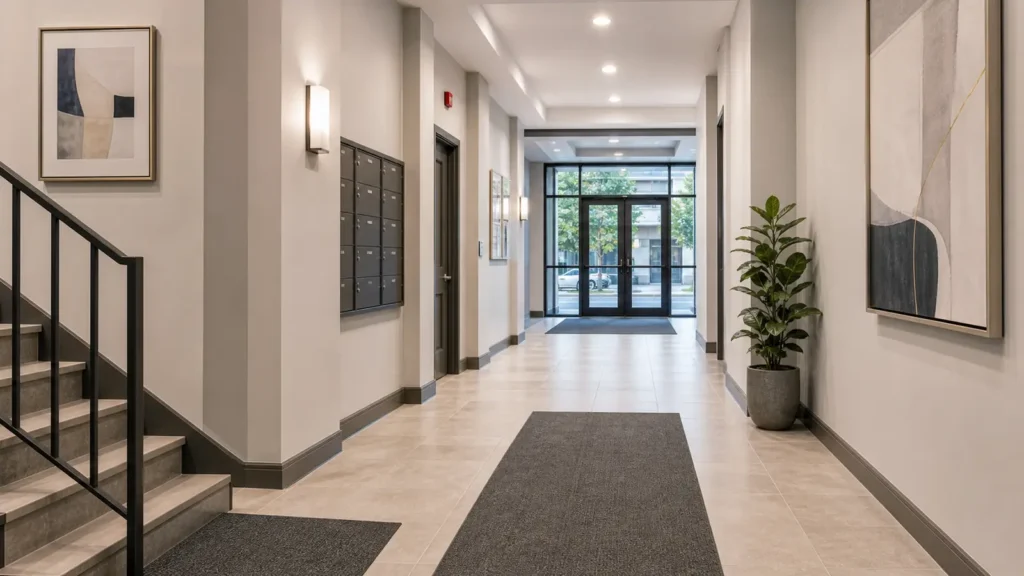
Most building owners find out how their common areas score the same way: an evaluation happens, a number lands, and it turns out cleanliness was worth more of it than anyone expected. RentSafeTO is not a cleaning bylaw, but a meaningful share of what it measures is decided by whether corridors, stairwells, garbage rooms and laundry areas are consistently maintained.
Here is how the common area side of it actually works, and what separates buildings that score well from buildings that keep getting re-evaluated.
What is RentSafeTO?
RentSafeTO is the City of Toronto’s Apartment Building Standards programme. It applies to rental buildings with three or more storeys and ten or more units, requiring owners to register, meet maintenance standards, and undergo periodic City evaluations of common areas, building systems and grounds.
Evaluations score building elements across several categories. Buildings that score below the threshold face more frequent evaluation and can be required to produce a formal action plan. Buildings that score well are evaluated less often. That difference is worth real money over a few years, and cleanliness is one of the few inputs an owner can fix quickly.
Condominiums are not covered by RentSafeTO, which applies to rental apartment buildings. Condo boards face a different pressure, which is owners and residents rather than the City, but the standard that satisfies one tends to satisfy the other.
Which common areas get looked at?
Evaluators walk the parts of the building every resident and visitor uses. In practice that means the spaces where poor cleaning is most visible and hardest to hide on the day of an inspection.
- Entrance, vestibule and lobby
- Corridors on every floor, not just the ground floor
- Stairwells, including the ones nobody uses
- Elevators, including tracks and cab interiors
- Garbage and recycling rooms, and the chute rooms on each floor
- Laundry rooms
- Shared amenity and community rooms
- Parking levels and their entrances
- Exterior grounds, walkways and the area around waste storage
The pattern in low scores is consistent, and it is rarely the lobby. It is the fifth floor chute room, the stairwell nobody walks, and the parking level entrance. Buildings clean what residents comment on and lose points on what they do not.
Why garbage rooms decide more than they should
Waste storage is the highest-risk common area in almost every apartment building, because it fails faster than anything else and it fails in ways that are immediately obvious: odour, pests, overflow, and residue on the floor that never gets properly removed.
A weekly sweep does not hold a garbage room. Chute rooms need attention on a frequency matched to how fast the building fills them, bins need washing rather than just emptying, and the floor needs periodic degreasing because compacted waste leaves residue that a mop moves around instead of removing.
It is also the area most likely to generate a pest complaint, and pest management sits inside the same evaluation. One neglected room can pull down two categories at once.
What frequency actually holds a standard?
There is no single mandated schedule, because a 24 unit walk-up and a 300 unit tower do not degrade at the same rate. What follows is the frequency that reliably holds condition in Toronto rental buildings, which is the practical benchmark worth working to.
| Area | Workable frequency | What fails without it |
|---|---|---|
| Lobby and entrance | Daily | First impression, tracked-in salt, slip risk |
| Corridors | 2 to 3 times weekly | Carpet soiling, odour retention |
| Stairwells | Weekly | Debris build-up, the classic missed score |
| Elevator cabs and tracks | Daily wipe, weekly detail | Visible grime in the most-used space |
| Chute rooms | Daily to every other day | Odour, overflow, pest attraction |
| Main garbage room | Daily, with periodic degrease | Pests, residue, the highest-risk failure |
| Laundry room | 2 to 3 times weekly | Lint accumulation, which is also a fire risk |
| Parking levels | Monthly, seasonal after winter | Salt residue, dust, drainage blockage |
Winter changes this. From November to April, entrance and lobby frequency should rise rather than hold, because salt and slush arrive continuously rather than on a schedule. Buildings that keep a summer frequency through winter are the ones with permanently damaged entrance flooring.
Why documentation matters as much as the cleaning
This is the part most owners get wrong. Doing the work and being able to demonstrate the work are two different things, and only one of them helps during an evaluation or a tenant dispute.
A signed log showing which areas were serviced, on which date, by whom, converts a verbal claim into a record. When a complaint is raised about a specific corridor on a specific week, a log answers it in seconds. Without one, the building is arguing from memory.
The same applies to the written scope. If your cleaning contract says “common areas” and nothing else, then nobody has agreed whether the fifth floor chute room is included, and it probably is not being done.
The three failures that cost buildings the most
Cleaning to a schedule instead of to a condition
A crew that arrives Tuesday and Friday will leave a building looking acceptable on Tuesday and Friday. Traffic does not respect that. Buildings with heavy daytime use need someone present during occupied hours, which is what day porter coverage exists for.
Treating the garbage room as a cleaning task rather than a system
Emptying bins is not the same as maintaining a waste room. Bin washing, floor degreasing and chute room frequency are separate line items and need to be written in as such. This is exactly what garbage room cleaning covers as a defined scope rather than an assumption.
No periodic floor care programme
Corridor and lobby flooring degrades on a multi-year curve that daily cleaning slows but does not stop. Without scheduled floor care, hard surfaces dull and carpet holds soil permanently. By the time it is visible in an evaluation, the fix is replacement rather than restoration.
Common questions
Does RentSafeTO apply to condominiums?
No. RentSafeTO covers rental apartment buildings with three or more storeys and ten or more units. Condominiums are governed separately, though condo common area standards are driven by owners and boards to a similar level.
How often are buildings evaluated?
Evaluation frequency depends on how the building scored previously. Buildings scoring below the threshold are re-evaluated sooner and face additional requirements. Scoring well is what buys you a longer interval, so cleanliness compounds over time.
Is a cleaning log actually required?
Owners are expected to be able to demonstrate that maintenance is happening, and records are the practical way to do that. Whether or not a specific log format is demanded, a building that cannot evidence its cleaning schedule is in a materially weaker position.
Which common area causes the most problems?
Waste storage, consistently. It degrades fastest, generates odour and pest complaints, and pulls down more than one evaluation category at once. It is also the area most often under-specified in cleaning contracts.
Can one cleaner cover a whole building?
It depends on unit count, floor count and traffic. A small walk-up can be held by scheduled visits. A large tower with heavy daytime use generally needs daytime presence plus a nightly crew, because a single visit cannot hold nine common area types across many floors.
What should be in the written scope?
Every area by name, the frequency for each, who supplies consumables, what triggers an extra charge, and what the reporting looks like. If the contract says “common areas” without a list, assume the areas you care about most are not included.
Where to start
Walk your own building the way an evaluator would: top floor down, stairwells included, chute room on every level, parking entrance last. Do it mid-week rather than the morning after a clean. Whatever you find is what your evaluation will find.
We maintain common areas for rental and condominium buildings across Toronto and the GTA, on a written scope with a service record per visit. If your last evaluation flagged cleanliness, we will walk the building and tell you which areas are actually pulling the score down.
Two related pieces go deeper. Day porter vs janitorial service explains which model actually holds a busy residential building through the day, and the office cleaning checklist sets out the daily, weekly and monthly tiers a common area scope should be built on.
Need this handled at your building?
Written scope before work, completion log after every visit, same crew every time. WSIB certified and $5M insured across Toronto and the GTA.