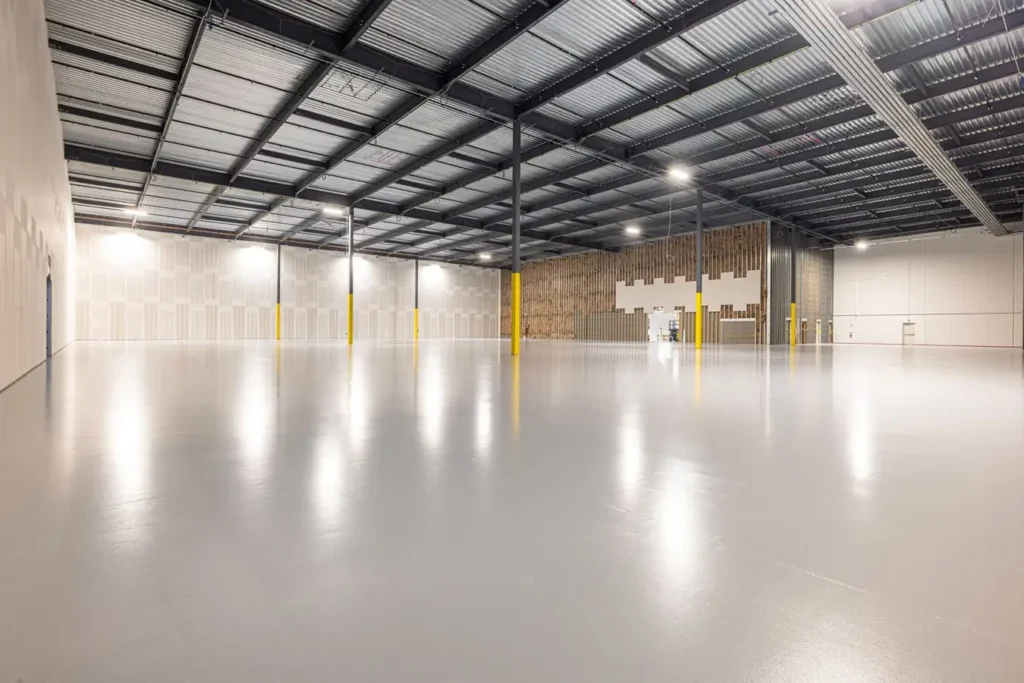
A warehouse and a distribution centre look similar from the parking lot and clean nothing alike. A warehouse stores things. A distribution centre moves them, continuously, often around the clock, and that single difference changes every assumption a cleaning contract normally makes.
The biggest of those assumptions is that the building stops.
What is distribution centre cleaning?
Distribution centre cleaning is industrial cleaning scheduled around continuous operation rather than around closing time. Because the building rarely stops, work is planned into shift changes and low-throughput windows, zone by zone, instead of being done overnight while the site is empty.
The practical consequence is that scheduling becomes the hard part of the contract, not the cleaning method.
Five things that make a DC different
| Factor | Storage warehouse | Distribution centre |
|---|---|---|
| Operating pattern | Business hours, quiet overnight | Two or three shifts, often 24/7 |
| Forklift movement | Intermittent | Constant, high aisle traffic |
| Dock activity | A few deliveries daily | Continuous inbound and outbound |
| Cardboard volume | Moderate | Very high, fibre everywhere |
| Cleaning window | Overnight, whole floor | Shift gaps, zone by zone |
The last row is the one that breaks contracts written for storage facilities. A crew that expects an empty building and arrives to a live pick face cannot do the job as quoted.
Cardboard fibre is the signature problem
Every carton opened, every pallet wrapped, every box broken down sheds fibre. In a distribution centre that happens thousands of times a day, and the result is a fine paper dust that behaves differently from the mineral dust in a storage warehouse.
It is light, so it travels much further on air movement. It settles on racking, on conveyor housings, on light fittings and inside anything with a fan. It is also combustible in accumulation, which is why fibre build-up on electrical equipment and in ceiling voids is worth taking seriously rather than treating as untidiness.
Sweeping it is the worst option available, for the same reason sweeping concrete dust is: it launches the fine fraction into the air instead of removing it. Vacuum with filtration, or scrub.
Aisles wear at a completely different rate
Forklift traffic in a DC is concentrated into travel aisles and the dock apron. Those areas take a volume of movement the rest of the floor never sees, and they degrade accordingly: tyre marking, sealer wear, and eventually surface abrasion of the slab itself.
Cleaning the whole floor at one uniform frequency therefore over-services the racking bays and under-services the aisles. A zoned schedule works better: travel aisles and dock daily or near-daily, bays and low-traffic areas weekly, high level quarterly.
If the slab in the aisles has started dusting, no frequency fixes it, because the floor is generating the dust. That needs densifying or sealing, which is a floor care treatment rather than a cleaning task. We covered the test for it in warehouse floor dust.
Scheduling around a building that never stops
This is where the contract is won or lost.
Find the real gaps, not the nominal ones
Almost every 24/7 site has quieter windows: between shift handover, after the last outbound wave, before the first inbound. They are rarely on any published schedule and the floor supervisor knows exactly when they are. Ask them, not the org chart.
Work zones, not floors
A scrubber can run one aisle while picking continues two aisles over, provided the route is agreed and marked. Trying to do the whole floor at once requires a shutdown nobody will authorise.
High-level work needs the floor beneath it clear
This is the only genuinely disruptive part, and it goes into planned downtime, a weekend, or a scheduled maintenance window. Quarterly is usually enough, so it is a planning problem rather than a recurring one.
The pick face is its own problem
Racking in a storage warehouse is mostly static. In a distribution centre the lower levels are a pick face handled constantly, and it accumulates a specific kind of mess: torn shrink wrap, banding, label backing, crushed carton corners and product spill.
That debris is more than untidiness. It ends up under pallet truck wheels, gets pushed into aisles where it becomes a trip hazard, and in food-adjacent facilities it attracts pests. It also sits at exactly the height a visiting auditor looks first.
- Pick face bays need daily debris clearance, separate from floor cleaning
- Upper racking levels need quarterly high-level vacuuming, because nobody sees them until they shed
- Beam and upright faces collect fibre dust that obscures load rating labels
- Under-racking is where debris migrates, and it is routinely missed entirely
Under-racking is the one worth naming explicitly in a scope. It is out of sight, awkward to reach, and exactly where a contractor quietly saves time when nobody has specified it.
Audit readiness is a cleaning outcome
Distribution centres get audited by customers, by certification bodies, and in food or pharmaceutical supply chains by regulators. Housekeeping is almost always assessed, and it is one of the easiest sections to fail on appearances alone.
A facility that cleans to a written schedule and keeps a record walks into an audit with evidence. A facility that cleans reactively has an opinion. Ask any provider what record they leave behind after each visit, because in an audit that document is worth nearly as much as the work.
The parts that are not the warehouse floor
A distribution centre runs shifts, which means it has amenities running at hours a normal building does not.
Lunchrooms turn over three times a day rather than once. Washrooms take continuous use across all shifts and cannot wait for an overnight visit that never comes, because there is no overnight. Locker rooms, the driver waiting area and the shipping office all need attention within operating hours.
This is where daytime coverage stops being optional. A site running three shifts needs someone maintaining amenities during the day, which is the same argument as day porter coverage in an office building, applied to a facility where the failure mode is a washroom that has been out of supply since the second shift started.
Common questions
Can you clean without stopping operations?
Yes for floors, amenities and dock areas, which are done zone by zone around live activity. High-level dusting is the exception and needs the area beneath it clear, so it is scheduled into planned downtime.
How often should distribution centre floors be cleaned?
Travel aisles and dock aprons daily or near-daily with a scrubber. Racking bays and low-traffic areas weekly. High-level surfaces quarterly. Throughput drives all three more than square footage does.
Do your crews need site safety training?
Yes. Working around live forklift traffic requires site induction, high-visibility clothing and awareness of designated pedestrian routes. Any provider who treats a live DC like an empty office is a hazard to your operation.
What about cardboard dust on equipment?
It needs vacuuming with filtration, not brushing or compressed air. Both of those relocate it, and accumulation on electrical equipment and conveyor motors is a genuine fire consideration rather than a cosmetic one.
Can amenities be cleaned across all shifts?
They have to be. Washrooms and lunchrooms serving three shifts cannot run on a single overnight visit. Most sites need a daytime presence for amenities plus a heavier periodic clean in a quiet window.
Is this priced like warehouse cleaning?
Similar inputs, different scheduling. Zoned work around live operations takes longer than the same area cleaned in an empty building, and shift-gap timing carries a premium. Both should be visible in the quote rather than discovered later.
Where to start
Ask your floor supervisor when the genuinely quiet windows are, then check whether your current contract uses any of them. Most do not, because they were written on the assumption the building empties at some point.
See warehouse and industrial cleaning for how we scope facilities around live operations. We will walk the site during a working shift, which is the only way to see what the schedule actually has to fit around.
Need this handled at your building?
Written scope before work, completion log after every visit, same crew every time. WSIB certified and $5M insured across Toronto and the GTA.
Keep Reading

Winter Entrance Matting: The Six Weeks That Decide Your Floor Budget
Most commercial floor budgets are decided in November, and almost nobody realises it. Whatever arrives through your entrance between the first snowfall…
Warehouse Floor Dust: Why Sweeping Makes It Worse
Walk into a warehouse mid-afternoon and look at a shaft of light coming through a skylight. The air is full of dust.…

Winter Salt and Your Commercial Floors: A Toronto Guide
Between November and April, road salt does more damage to Toronto commercial floors than the rest of the year combined. It arrives…