Walk into a warehouse mid-afternoon and look at a shaft of light coming through a skylight. The air is full of dust. Someone swept that floor this morning, which is precisely why.
Dry sweeping a warehouse floor does not remove fine dust. It launches it, lets it settle on racking, product and lungs, and moves the problem around. Here is what is actually happening and what works instead.
Why does sweeping make warehouse dust worse?
A broom only captures particles heavy enough to be pushed along the floor. Anything finer is thrown into the air, where it stays suspended for hours before settling on racking, inventory and horizontal surfaces well away from where it started. The floor looks clean because the visible debris moved. The fine fraction, which is the part that matters for both product and health, was redistributed rather than removed.
That is why a swept warehouse can look tidy at floor level and still leave a film on everything at eye height by the next morning.
Where warehouse dust actually comes from
It is rarely one source, which is why single-fix approaches disappoint.
- Concrete itself. Unsealed or worn slab abrades under forklift traffic and generates fine dust continuously. The floor is the source.
- Tyre and wheel wear from forklifts and pallet trucks, concentrated in travel aisles.
- Cardboard and pallet fibre shed every time a load is broken down or wrapped.
- Product dust where anything granular, powdered or fibrous is handled.
- Outside air through dock doors that spend the day open.
The first one is the one operations teams miss most often. If the slab is generating dust, cleaning frequency will never solve it, because you are removing dust the floor keeps making.
What works instead
| Method | What it does | Right for |
|---|---|---|
| Dry sweeping | Moves coarse debris, launches fine dust | Almost nothing on its own |
| Industrial sweeper | Collects debris with filtration and dust suppression | Large open floors, routine debris |
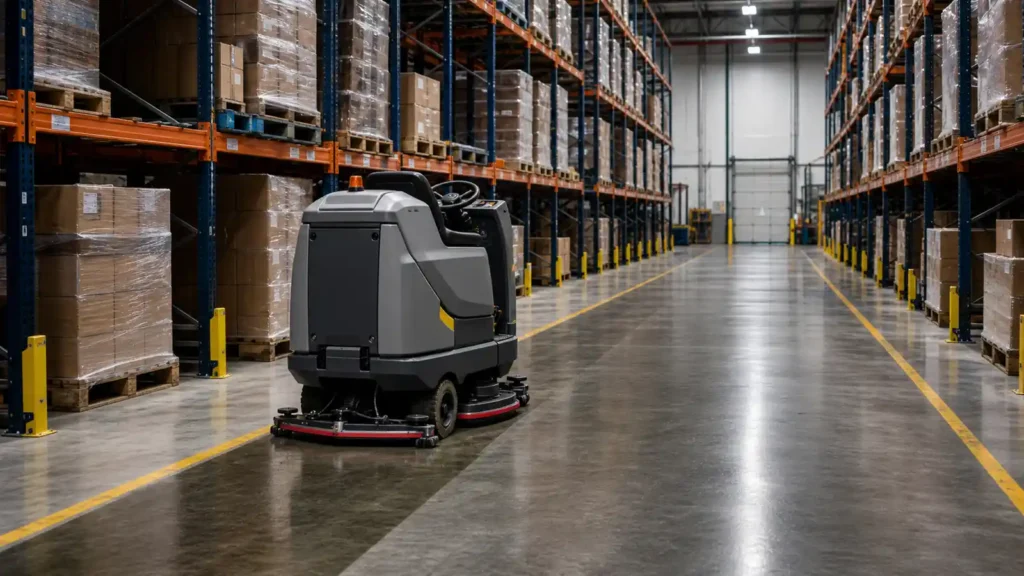
| Ride-on scrubber | Water and pad lift fine dust with no airborne phase | The core method for most warehouses |
| HEPA vacuum | Captures fine particles instead of recirculating | Racking, ledges, around equipment |
| Concrete sealing or densifying | Stops the slab generating dust at source | Dusting or worn concrete |
The pattern is straightforward: anything that lifts dust into the air is the wrong tool, and anything that traps it at the point of contact is the right one. A ride-on scrubber does the bulk of the work in most facilities, because water suppresses the fine fraction entirely.
If the slab is the source, cleaning is not the fix
There is a simple test. Run a hand firmly across a clean section of the floor. If it comes away chalky and grey, the concrete is dusting: the surface is breaking down and releasing fine particles under traffic.
No cleaning schedule fixes that, because the floor regenerates the dust between visits. The fix is a densifier or sealer, which hardens the surface and stops the abrasion at source. It is a one-off treatment with a multi-year life, and in a dusting facility it does more than doubling cleaning frequency ever will.
Worth checking before you spend money on more frequent visits. That treatment sits within commercial floor care rather than routine cleaning.
The silica question
Concrete dust contains crystalline silica. In Ontario, respirable crystalline silica is a designated substance under occupational health and safety regulation, with employer obligations around assessment and control.
Most warehouses are nowhere near a threshold that triggers formal controls, and this is not a reason for alarm. But it is a solid reason not to have someone dry sweeping a dusting concrete floor every morning, because that is the one routine activity in a warehouse that reliably puts concrete dust into the air people breathe.
Switching to wet or filtered methods removes the question entirely. It is a cheap way to stop a problem you would otherwise have to assess.
The surfaces above floor level
Floor cleaning gets the attention because it is visible. The dust that causes complaints is usually somewhere else.
Racking beams, particularly upper levels nobody looks at. Ledges, conduit runs and sprinkler pipework. The tops of light fittings. Ventilation grilles. Every one of these accumulates for months, and every one dumps its load the moment a forklift passes underneath or the heating cycles on.
High-level dusting on a quarterly cycle with a HEPA vacuum, rather than a brush, is what stops that. Brushing high surfaces is the same mistake as dry sweeping, just at height.
Dock doors are a dust inlet nobody manages
A dock door open for six hours a day is a six-hour opening to whatever is blowing around outside: road grit in summer, salt and slush from November, and the exhaust and tyre dust of every truck that backs up to it.
Three things reduce it, none of them expensive. Matting immediately inside each dock door, sized properly and actually cleaned rather than just present. Keeping doors closed between deliveries rather than parking them open for convenience. And treating the dock apron itself as part of the cleaning scope, because dirt on the apron gets driven straight inside.
Matting is the highest-return item on that list and the most neglected. A mat that is never cleaned stops absorbing and becomes a reservoir that redistributes grit onto forklift tyres, which then carry it down every aisle in the building.
Working around a live operation
Warehouses rarely stop, which is the practical constraint on all of this.
Scrubbing runs aisle by aisle around picking activity rather than closing the floor. High-level work goes into shift gaps or weekends, because it needs the area beneath it clear. Dock areas get done between deliveries. In a genuine 24/7 operation the work follows the quietest shift rather than the calendar, which is a scheduling problem rather than a cleaning one.
Facilities running full shifts often pair this with daytime coverage for lunchrooms and washrooms, since those cannot wait for an overnight visit either.
Common questions
How often should a warehouse floor be cleaned?
Travel aisles and dock areas daily or every other day with a scrubber. Full floor weekly in most facilities. High-level dusting quarterly. Higher throughput and more forklift movement push all of those up.
Is sweeping ever appropriate?
For coarse debris like broken pallet wood or spilled product, yes, as a first pass before scrubbing. As the primary daily method on a concrete floor, no. It moves the fine fraction rather than removing it.
Why is there dust again the day after cleaning?
Two usual causes. Either the slab is dusting and generating fresh particles, or high-level surfaces were never cleaned and are shedding downward. Check the floor with your hand first, then look up.
What is concrete densifying?
A chemical treatment that reacts with the concrete to harden the surface, so it stops abrading and releasing dust under traffic. It is a one-off with a multi-year life and it addresses the source rather than the symptom.
Can cleaning happen without stopping operations?
Yes. Scrubbing works aisle by aisle around live picking. Only high-level work needs the area beneath it clear, and that is scheduled into shift gaps rather than requiring a shutdown.
Does dust affect stored product?
It does where packaging is open, where product is food-adjacent, or where cartons are customer-facing on arrival. A dusty carton arriving at a retail client reflects on the shipper, not the warehouse, which is a commercial cost rather than a housekeeping one.
Where to start
Do the hand test on the slab. If it comes away chalky, deal with the concrete before you touch the cleaning schedule. If it comes away clean, the dust is arriving from racking, dock doors or product handling, and the fix is method and frequency.
Either way, stop dry sweeping. It is the one thing guaranteed to move the problem rather than solve it.
See warehouse cleaning for how we scope industrial facilities around live operations, or winter salt and floor damage for what dock doors let in from November onward.
Need this handled at your building?
Written scope before work, completion log after every visit, same crew every time. WSIB certified and $5M insured across Toronto and the GTA.
Keep Reading
Distribution Centre Cleaning: When the Building Never Stops
A warehouse and a distribution centre look similar from the parking lot and clean nothing alike. A warehouse stores things. A distribution…

Winter Entrance Matting: The Six Weeks That Decide Your Floor Budget
Most commercial floor budgets are decided in November, and almost nobody realises it. Whatever arrives through your entrance between the first snowfall…

Winter Salt and Your Commercial Floors: A Toronto Guide
Between November and April, road salt does more damage to Toronto commercial floors than the rest of the year combined. It arrives…