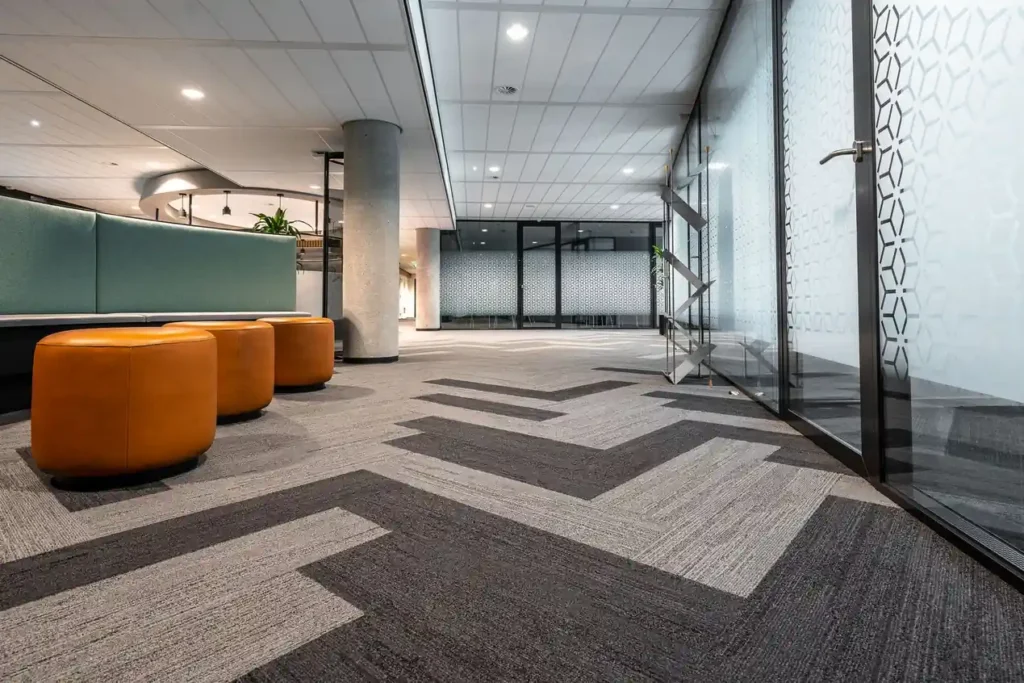
Almost every office cleaning quote starts with the wrong question. The buyer asks what it costs, the provider asks how many square feet, and nobody establishes the thing that actually determines both: how often the space needs attention.
Frequency is the single biggest lever on a cleaning budget. Get it right and you spend less for a better-looking office. Get it wrong in either direction and you either waste money or slowly damage the space.
How often should an office be cleaned?
Most offices need daily cleaning of washrooms, kitchens and high-touch surfaces, with full floor care two to three times a week and periodic deep cleaning quarterly. Offices under about fifteen people can often drop to two or three visits a week, provided washrooms and kitchens are covered every day the office is occupied.
The reason washrooms and kitchens set the floor on frequency is simple: they fail on a use cycle, not a time cycle. Ten people can exhaust a washroom’s supplies in a morning. A desk area does not degrade at anything like that rate.
Frequency by headcount
Headcount is a better starting point than square footage, because people generate the soil. A sparsely occupied 8,000 square foot office needs less than a packed 4,000 square foot one.
| Office size | General cleaning | Washrooms and kitchen | Deep clean |
|---|---|---|---|
| Under 15 people | 2 to 3 times weekly | Daily when occupied | Twice yearly |
| 15 to 50 people | Daily or 3 to 5 times weekly | Daily | Quarterly |
| 50 to 150 people | Daily | Daily, plus midday check | Quarterly |
| 150+ or multi-floor | Daily, plus daytime coverage | Daily, plus scheduled rounds | Quarterly, zoned |
| Client-facing regardless of size | Daily | Daily, plus midday check | Quarterly |
That last row matters more than people expect. If clients walk through your space, the office is part of how they judge the business, and the correct frequency is set by that rather than by headcount.
What should be cleaned daily?
Daily items are the ones where a single skipped day is noticeable or unhygienic. Everything else can run on a longer cycle without anyone perceiving a drop in standard.
- Washrooms cleaned, disinfected and restocked
- Kitchen and break area surfaces, sink and appliance exteriors
- Waste and recycling emptied
- High-touch points: door handles, light switches, lift buttons, shared equipment
- Reception and entrance presentation
- Meeting rooms reset after use
- Entrance matting and hard floor at the door, especially in winter
Notice that desks are not on the list. Individual desk cleaning is usually the least valuable daily line item in an office contract, and most providers include it because clients expect it rather than because it earns its place.
What runs weekly, monthly and quarterly?
Weekly
Full vacuum of all carpeted areas including edges and under-desk zones, mopping of all hard floors, interior glass and partition marks, dusting of surfaces and sills, and a proper clean of the kitchen interior including the fridge exterior and microwave.
Monthly
High dusting of vents, ledges and light fittings, skirting and baseboards, door frames, and spot treatment of carpet marks before they set permanently. This is the tier most contracts quietly omit, and its absence takes about six months to become visible.
Quarterly
Carpet extraction, hard floor machine scrubbing or restoration, upholstery cleaning, interior windows, and a full deep clean of kitchens and washrooms including descaling and grout work. See commercial deep cleaning for what a proper quarterly scope covers.
Why under-cleaning costs more than it saves
Cutting frequency looks like a saving on the invoice and usually is not, because the costs move somewhere less visible.
Carpet is the clearest example. Soil that stays in carpet fibres acts as an abrasive every time someone walks on it, cutting the fibres. That damage does not reverse with a later clean. A carpet cleaned on a proper cycle lasts materially longer than one rescued occasionally, and replacement is far more expensive than the cleaning that would have prevented it. The same logic applies to hard floor finishes, where salt and grit strip the protective layer and expose the substrate.
The second cost is staff perception. Washroom supplies running out mid-afternoon and a kitchen that is unpleasant by Thursday are small things that people talk about, and they are read as a signal about how the business is run.
Toronto changes the answer for five months
Any frequency plan written for a Toronto office needs a winter variant. From November to April, salt, slush and grit arrive continuously through the entrance, and they do two things at once: create a slip hazard, and abrade every floor surface they reach.
Entrance areas need attention several times a day in that period rather than once. Matting needs cleaning rather than just existing. We covered the damage side of this in detail in winter salt and commercial floor damage. A contract that holds one frequency across the whole year is over-serviced in July and under-serviced in January.
Writing frequency into the contract properly
A frequency plan that lives in an email is not a frequency plan. The reason cleaning quality drifts on long contracts is almost never that the provider changed their mind. It is that nothing was specific enough to drift from.
Four things need to be written down explicitly, and the absence of any one of them is where disputes come from six months later.
Frequency per area, not per building
“Weekly cleaning” is not a specification. Washrooms daily, general areas three times weekly, high dusting monthly, carpet extraction quarterly: that is a specification, and it can be checked.
Who supplies consumables
Paper, soap and liners are a real cost and a real source of argument. Decide whether they are on you or the provider, and if they are on the provider, state the standard rather than leaving it to whatever is cheapest.
What triggers an extra charge
Events, move-ins, post-renovation dust and one-off spill response should have an agreed basis before the first one happens, not an invoice afterwards.
What gets recorded
A short service record per visit turns a quality conversation from opinion into fact. It also tells you quickly whether the monthly tier is actually being done, which is the one most likely to quietly disappear.
Common questions
Is daily office cleaning necessary?
For washrooms, kitchens and waste, yes, on every day the office is occupied. For general cleaning it depends on headcount and whether clients visit. Smaller offices frequently run two to three general visits a week with daily washroom coverage.
Should cleaning happen during or after office hours?
After hours for the main clean, because equipment and access are unrestricted. Larger and client-facing offices add daytime coverage for washrooms, kitchens and entrances, which is what a day porter provides.
How often should office carpets be deep cleaned?
Quarterly in most offices, twice yearly in low-traffic spaces, and more often in entrances and corridors. Waiting until carpet looks dirty means the abrasive damage has already happened.
Does frequency change the price proportionally?
No. Going from three visits to five does not increase cost by two thirds, because a large part of each visit is fixed setup, travel and washroom work. Higher frequency usually improves the cost per visit.
What if we have hybrid staff and variable occupancy?
Match frequency to your busy days rather than your average. If Tuesday to Thursday are full and Monday and Friday are quiet, weight the schedule to those three days instead of spreading visits evenly.
How do we know our current frequency is wrong?
Two reliable signals: complaints clustering on the same weekday, and washroom supplies running out before the next visit. Both mean the interval is longer than the space can hold.
Setting your own frequency
Start from headcount and client visibility, set washrooms and kitchens to daily, then decide general cleaning around them. Add a winter variant for the entrance. Put quarterly floor care in the contract rather than treating it as an extra you will get to later, because that is the line item that protects the asset.
Our office cleaning checklist covers what belongs in each tier, and office cleaning services explains how we scope it. If you want the frequency set properly, we will walk your office on a busy afternoon and write it against what we find rather than against a template.
Need this handled at your building?
Written scope before work, completion log after every visit, same crew every time. WSIB certified and $5M insured across Toronto and the GTA.
Keep Reading

Cleaning Plans for Small Toronto Businesses
Cleaning plans for small Toronto businesses: compare visit schedules, assign daily tasks and use a practical template to control costs and quality.
Medical Office Cleaning Standards: What a Clinic Should Expect
A clinic gets judged on cleanliness in about four seconds, before anyone has spoken to reception. But the standard that matters is…
West End Office Cleaning: Converted Buildings Are Different
The West End has more office space than most people realise, and almost none of it is in an office building. It…