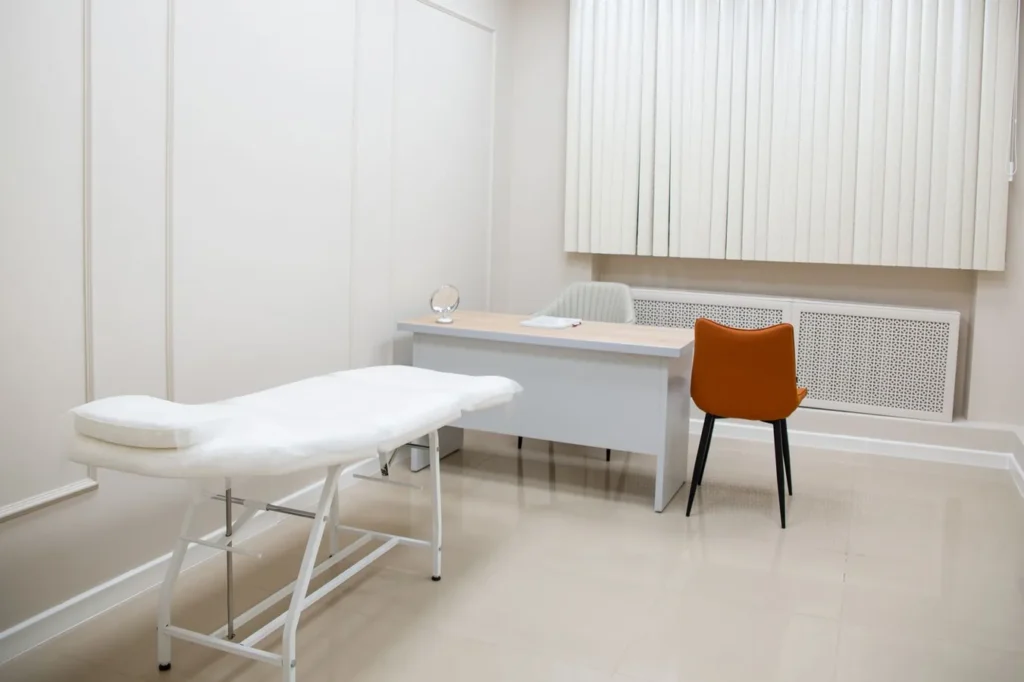
A clinic gets judged on cleanliness in about four seconds, before anyone has spoken to reception. But the standard that matters is not the one patients can see. It is whether high-touch surfaces are being disinfected with the right product, for the right contact time, in the right order, by someone who knows why the order matters.
Most commercial cleaning contracts do not describe any of that. Here is what a medical office should actually expect, and how to tell whether you are getting it.
What standards apply to medical office cleaning in Ontario?
Medical office cleaning in Ontario is shaped by infection prevention and control (IPAC) principles from Public Health Ontario, and by WHMIS requirements covering the safe handling of disinfectants. Clinics are not hospitals, so the obligations are lighter, but the underlying method of cleaning first, disinfecting second, and respecting contact time is the same.
The practical distinction worth understanding is between cleaning and disinfection. Cleaning removes soil physically. Disinfection kills organisms chemically, and it only works on a surface that has already been cleaned. A disinfectant wipe dragged across a visibly soiled surface accomplishes very little, because organic matter blocks the chemistry.
This is also where most general commercial cleaning falls short in a clinic. Not through carelessness, but because a crew trained on offices is trained to make surfaces look clean, which is a different goal.
What is contact time and why does it decide everything?
Contact time, sometimes called dwell time, is how long a disinfectant must stay visibly wet on a surface to actually kill the organisms on its label. It is set by the manufacturer and typically runs from one to ten minutes. If the surface dries early, the disinfection did not happen.
This is the single most commonly broken rule in clinic cleaning. Someone sprays an exam table, wipes it dry immediately because a dry surface looks clean, and moves on. The surface now looks disinfected and is not. The correct behaviour looks worse: apply, leave it wet, come back.
When you are evaluating a cleaning provider, ask what contact time their disinfectant requires. A provider who cannot answer is not following one.
Cleaning zones: not every room is equal
A clinic should be cleaned in zones, with different frequencies and different methods, rather than as one continuous space.
| Zone | Risk | Expected treatment |
|---|---|---|
| Exam and treatment rooms | Highest | Disinfect all touch points and the exam surface between clean cycles, full disinfection daily |
| Washrooms | High | Daily disinfection, restock on a checked schedule, separate cloths and equipment |
| Waiting room | Moderate to high | Daily disinfection of chairs, arms, door handles, reception counter and any shared items |
| Reception and admin | Moderate | Daily clean, touch point disinfection, keyboards and phones included |
| Corridors and stairs | Lower | Daily clean, periodic floor care |
| Staff room | Moderate | Daily clean including sink and fridge exterior, touch points disinfected |
The zone principle also governs equipment. Cloths and mop heads used in a washroom should never appear in an exam room, which is why colour-coded microfibre exists. One cloth carried between zones undoes the entire system, and it is invisible unless someone is watching the method rather than the result.
Which surfaces are actually high-touch?
High-touch means touched frequently by many different people. These are the surfaces that transmit, and they are routinely missed because they are small and not visibly dirty.
- Door handles, push plates and door edges
- Light switches and thermostat controls
- Reception counter and the payment terminal
- Waiting room chair arms, not just the seats
- Exam table and the adjustable controls on it
- Blood pressure cuff housing, stool height levers, equipment handles
- Washroom taps, dispensers, flush handles and the inside of the door
- Shared keyboards, phones and clipboards
- Handrails and elevator buttons in the suite
Chair arms are the most consistently missed item in a waiting room. Every patient touches them, and almost nobody cleans them daily.
What a clinic cleaning provider should not claim
Worth stating plainly, because overclaiming is common in this category and it should make you cautious rather than reassured.
A commercial cleaning company does not sterilise anything. Sterilisation is an instrument reprocessing procedure carried out by clinical staff using an autoclave. Cleaning companies also do not handle biomedical waste, which is a licensed disposal stream with its own chain of custody. Any provider offering either is describing something they are not doing.
What a provider should offer is environmental cleaning and surface disinfection to a documented method, on a written scope, with staff who understand zones and contact time. That is the real job, and it is enough.
Scheduling around a clinic that is open
Most clinics need cleaning outside patient hours, which usually means evenings. That works for the daily reset but leaves a gap: a waiting room at 3pm has had six hours of traffic since anyone touched it.
Busier practices solve this with a short midday touch point round covering the waiting room, washrooms and reception, then a full evening clean. It is the same logic behind daytime porter coverage in office buildings, scaled to a clinic and focused on disinfection rather than presentation.
Five things to check before signing
Clinic cleaning is unusually easy to sell badly, because the buyer cannot inspect the thing they are actually paying for. These five checks separate a provider with a method from one with a vacuum.
- Named disinfectant and its contact time. If they cannot state both, there is no method behind the work.
- Equipment separation. Ask specifically how washroom cloths are prevented from reaching an exam room.
- Staff continuity. A rotating crew relearns your clinic every week and never reaches competence in it.
- Written zone scope. Each area named, with its frequency, rather than a single line reading “clinic cleaning”.
- Insurance and WSIB coverage. Non-negotiable for anyone working unsupervised in a space holding patient records.
The last one matters more in a clinic than in an office. Cleaning staff work after hours, alone, in a space containing confidential health information. That is a trust position, and it should be treated as one during procurement rather than assumed.
Common questions
What is the difference between cleaning and disinfecting?
Cleaning physically removes soil and organic matter. Disinfecting chemically kills organisms on an already-clean surface. Disinfectant applied to a soiled surface is largely wasted, because organic matter blocks it. Cleaning always comes first.
How often should a medical office be cleaned?
Daily at minimum, with exam rooms, washrooms and waiting areas disinfected every day the clinic operates. Busy practices add a midday touch point round. Periodic deep cleaning and floor care sit on top of the daily scope.
Do cleaners need specific training for clinics?
Yes. They need to understand zoning, high-touch surfaces, contact time, and WHMIS requirements for the products they carry. A crew trained only on offices will produce a clean-looking clinic without reliably disinfecting it.
What is colour-coded microfibre?
A system where cloths and mop heads are colour-assigned per zone, so washroom equipment can never be used in an exam room. It is the simplest available control against cross-contamination and it only works if it is enforced.
Can cleaners handle biomedical waste?
No. Biomedical and sharps waste is a licensed disposal stream handled by specialist contractors. A cleaning provider manages general and recycling waste only. Treat any provider claiming otherwise as a warning sign.
Does this apply to dental offices too?
Yes, with more emphasis on operatory surfaces, aerosol settling on nearby surfaces, and the boundary between what clinical staff reprocess and what environmental cleaning covers. That boundary should be written into the scope explicitly.
What should a clinic cleaning scope include?
Every zone by name with its frequency, a high-touch surface list, the disinfectant used and its contact time, the equipment separation method, consumables responsibility, and what gets recorded per visit. Anything vaguer is not a scope.
How to audit your current provider in ten minutes
Ask three questions. What disinfectant do you use and what is its contact time? How do you keep washroom equipment out of exam rooms? What do you record after each visit?
Confident, specific answers mean there is a method. Vague answers mean the surfaces look clean and nothing else is guaranteed. Then walk your own waiting room and run a finger along a chair arm.
We clean clinics, dental offices and medical suites across Toronto and the GTA on a documented scope. See medical office cleaning for what we cover, or read our office cleaning checklist for the general commercial equivalent. For pricing context, our guide to commercial cleaning costs explains what drives the number.
Need this handled at your building?
Written scope before work, completion log after every visit, same crew every time. WSIB certified and $5M insured across Toronto and the GTA.
Keep Reading
How Often Should an Office Be Cleaned?
Almost every office cleaning quote starts with the wrong question. The buyer asks what it costs, the provider asks how many square…
West End Office Cleaning: Converted Buildings Are Different
The West End has more office space than most people realise, and almost none of it is in an office building. It…

How Often Should Clinic Windows Be Cleaned?
A patient sitting in a waiting room has very little to look at. They will read the posters once, check their phone,…